

Employee surveys are broken. HR teams spend hours crafting questions, blast them out company-wide, and get back maybe 30% completion rates with answers like "fine" and "no comment." Meanwhile, real issues simmer beneath the surface, unspoken, unaddressed, and slowly eroding engagement.
Here's what changed: AI-powered conversational surveys don't just collect feedback, they have actual conversations. Instead of rigid forms, employees interact with adaptive AI that asks follow-up questions, picks up on context, and makes the whole process feel less like a chore and more like someone actually cares what they think.
This guide walks you through how conversational AI surveys work, why they drive higher engagement, and how to set one up in minutes.
What Makes AI Employee Feedback Surveys Different
Traditional employee surveys are like multiple-choice tests. Everyone gets the same questions in the same order, regardless of their role, tenure, or what they just said. You might ask "How satisfied are you with onboarding?" on a 1-5 scale, but you'll never know why someone circled 2 instead of 4.
AI employee feedback surveys flip this model entirely. Powered by conversational AI, these tools adapt in real time based on each response. If someone mentions feeling overwhelmed during onboarding, the AI immediately asks what specifically caused that stress. If they're enthusiastic about their manager, it explores what makes that relationship work.
The core differences:
- Dynamic questioning – The next question depends on the previous answer
- Natural language – Employees type freely instead of clicking boxes
- Intelligent follow-ups – AI probes deeper when it detects important signals
- Automatic synthesis – Converts conversations into themes and summaries
Conversational formats typically achieve higher completion rates than static forms. More importantly, the quality of feedback improves dramatically - employees share specific examples, stories, and suggestions instead of one-word answers.
Why HR Teams Are Switching to Conversational Surveys
The business case is straightforward: better data leads to better decisions, and better decisions improve retention and performance.
Higher Engagement From Day One
Static surveys feel like homework. Conversational surveys feel like someone asking "How's it really going?" Most people will ignore a 20-question form. Most people will respond when asked a genuine question.
The difference comes down to friction - adaptive conversations require less cognitive load and feel more respectful of employees' time.
Richer Insights You Can Actually Use
Checkbox data tells you what - maybe 40% of employees are dissatisfied with professional development. Conversational data tells you why - because the company canceled the training budget, managers don't discuss career growth in 1-on-1s, and high performers see no clear path forward.
This specificity transforms how HR responds. Instead of generic "improve professional development" goals, teams can address the actual root causes employees identified.
Instant Action Instead of Analysis Paralysis
Traditional survey tools dump raw data into spreadsheets. Someone has to manually read through hundreds of comments, code themes, and synthesize findings - a process that often takes weeks.
Modern AI platforms like Sinthax automatically summarize every conversation and highlight key insights from each response. You get clear summaries of what each person said instead of drowning in raw data.
Comparison at a glance:
| Factor | Static Forms | AI Conversational (Sinthax) |
|---|---|---|
| Follow-up questions | None | Adaptive based on answers |
| Analysis time | Days to weeks | Real-time |
| Insight depth | Surface-level metrics | Detailed responses with context |
| Employee experience | Feels like work | Feels like conversation |
How Conversational AI Surveys Actually Work
The technical magic happens behind the scenes, but the experience is remarkably simple for both HR teams and employees.
Setting Up Your First Survey (60 Seconds)
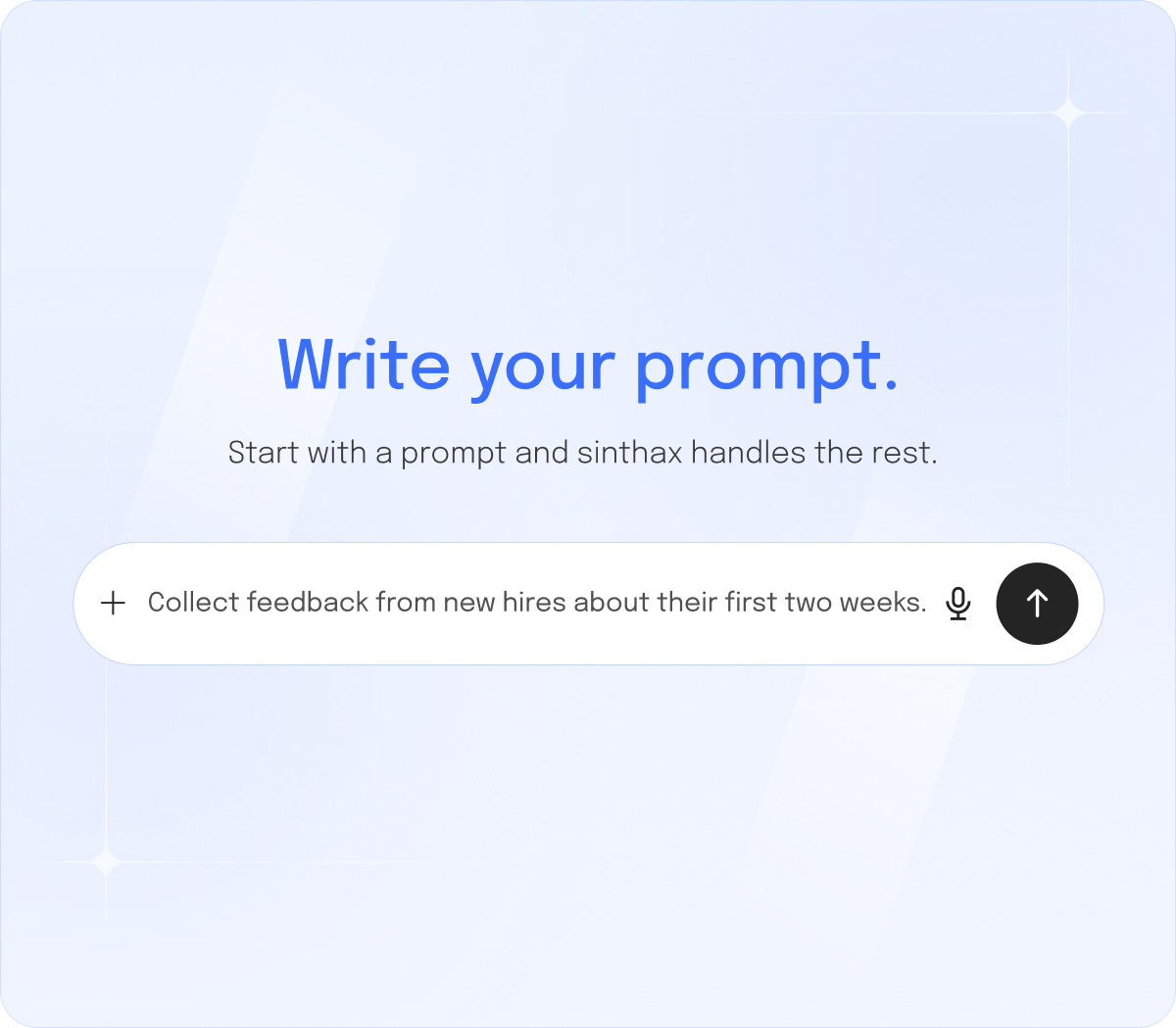
Here's the full process with Sinthax:
- Describe your goal in plain language – "Collect feedback from new hires about their first two weeks" or "Monthly pulse check on team morale"
- AI generates the conversation flow – Sinthax builds an adaptive question sequence, starting broad and drilling down based on responses
- Review and customize (optional) – Tweak the opening question, add specific topics you want covered, adjust tone
- Share everywhere – Get a link you can send via email, post in Slack, embed in your intranet, or include in onboarding docs
- Responses come in automatically – Each employee has a unique conversation shaped by their answers
No survey design experience needed. No scripting conditional logic. No manual analysis setup.
What Happens During the Conversation
From the employee's perspective, they click a link and start typing. The interface looks like a chat conversation - simple, familiar, low-pressure.
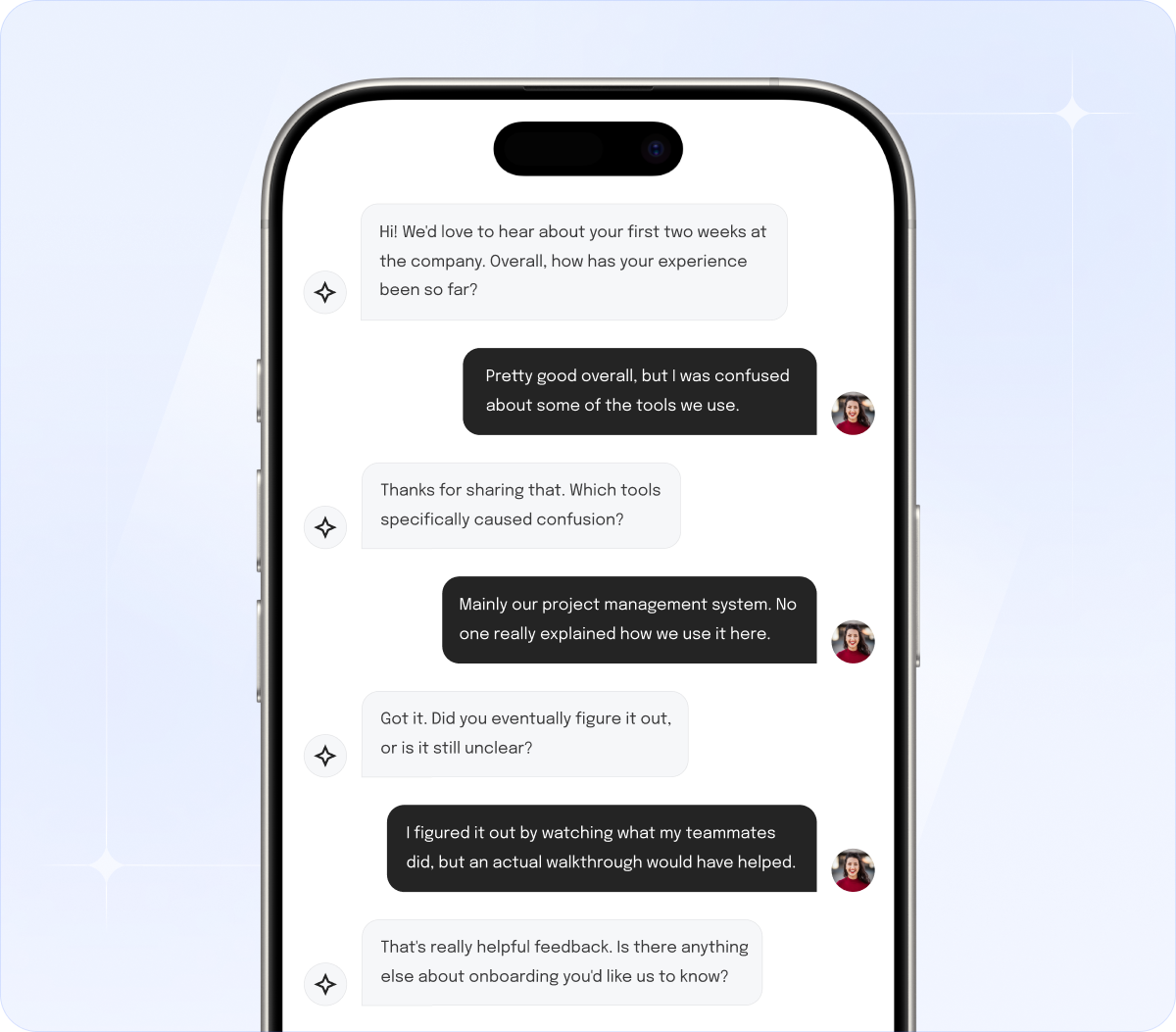
Notice how each question builds on the previous answer. The AI picked up on "confused about tools," asked for specifics, explored whether it was resolved, and gathered the exact improvement needed (a walkthrough). A static form would have missed all of that nuance.
Privacy and Ethics Built In
Employees won't open up if they don't trust the process. Conversational AI surveys address this through:
- Clear upfront messaging – Sinthax shows employees exactly how their responses will be used and who can see them
- Anonymous by default – Individual responses stay confidential unless employees explicitly choose to identify themselves
- Secure data handling – Encrypted transmission and storage with strict access controls
This transparency drives the honesty that makes conversational surveys valuable.
The Tangible Benefits Teams See Immediately
You Get Stories, Not Just Scores
Static surveys produce numbers. "Employee satisfaction: 6.2/10." Great, now what?
Conversational surveys produce narratives. "New hires consistently mention feeling welcomed by their teams but frustrated by IT setup delays. Top suggestion: ship equipment to home addresses before day one."
Those stories give leadership concrete, defendable reasons to change processes and budgets.
Action Items Surface Naturally
After collecting responses, Sinthax automatically generates a summary for each conversation with suggested actions:
- Individual response summaries with key insights highlighted
- Specific action suggestions based on what each person shared
- All responses organized and easy to review
HR can quickly scan through responses and identify what matters without manual analysis.
You Can Run Surveys More Often (Without Fatigue)
Traditional survey fatigue is real. Send out a 25-question form every quarter and watch completion rates crater.
Because conversational surveys feel less burdensome (most complete in under 5 minutes), you can run them more frequently without annoying your team. Monthly pulse checks become realistic. Event-specific feedback (post-onboarding, after team offsites, following major changes) becomes easy to collect while memories are fresh.
Scales From 10 to 10,000 Employees
Small teams get the same sophisticated AI as enterprises. There's no manual survey scripting, no hiring analysts to code qualitative responses, no bottleneck as headcount grows.
Whether you're a startup collecting feedback from your first 15 hires or a larger organization running engagement surveys, the setup process is identical. The AI handles the complexity.
Choosing the Right Platform: What to Look For
Not all "AI survey tools" are actually conversational. Many just use AI to generate static question lists - better than writing them yourself, but not fundamentally different from traditional forms.
Must-Have Features for HR Teams
When evaluating conversational AI survey platforms, prioritize:
- Ease of creation – If it takes 30 minutes to build a survey, you won't use it regularly. Look for prompt-based generation.
- Quality of adaptation – Test the demo yourself. Do follow-up questions feel relevant and natural, or robotic and generic?
- Analysis depth – Does the platform just transcribe conversations, or does it identify themes and patterns?
- Distribution flexibility – Can you share via email, Slack, Teams, embed on websites?
- Privacy controls – Can you guarantee anonymity? Is data handling transparent to employees?
Sinthax hits the sweet spot of powerful AI with minimal complexity. Set up a survey in seconds, share a link, and get actionable insights automatically.
Privacy, Ethics, and Compliance Checklist
Before deploying any AI feedback tool:
- ✅ Anonymity guaranteed – Individual responses can't be traced back unless employees opt in
- ✅ Clear data policy – Employees see exactly who can access responses and how data is used
- ✅ Secure infrastructure – Encrypted data transmission and storage
- ✅ Action transparency – Results are shared back with employees, closing the feedback loop
Sinthax meets all these criteria out of the box and provides HR teams with granular access controls.
Real-World Applications Across the Employee Lifecycle
Onboarding Feedback That Improves the Experience
Use conversational surveys to collect feedback after each new hire's first week. Instead of asking "How was onboarding?" on a 1-5 scale, the conversational format can uncover specific issues - like confusion about internal tools or unclear processes.
The adaptive follow-ups reveal exact improvements needed, like adding a tools walkthrough to day one or clarifying role expectations earlier.
Engagement Pulse Surveys That Catch Issues Early
Running monthly pulse checks helps monitor team sentiment over time. The conversational format makes it easy to identify emerging issues before they become major problems.
When patterns emerge - like multiple mentions of "communication gaps" or "workload concerns" - HR can flag and address them quickly instead of waiting for quarterly surveys.
Manager Feedback That Drives Coaching
One of the hardest feedback types to collect honestly is upward feedback about managers. Employees fear retaliation or awkwardness.
Conversational approaches, combined with guaranteed anonymity, unlock candid manager feedback. The AI asks questions like "What does your manager do that helps you succeed?" and "If you could change one thing about how your manager supports you, what would it be?"
Aggregated results give HR specific coaching topics for leadership development without exposing individual employees.
DEI and Psychological Safety Surveys
Sensitive topics require extra trust. Conversational AI surveys excel here because employees can express complex experiences in their own words rather than forcing them into checkbox categories.
The conversational format can reveal nuanced insights - like employees feeling comfortable sharing ideas but not comfortable admitting mistakes - a crucial distinction often buried in simple "psychological safety" scores.
Getting Started: Your First Conversational Survey in 60 Seconds
Ready to see the difference yourself? Here's how to launch your first survey with Sinthax today.
Step-by-Step Setup
- Visit Sinthax.com and start a free trial – No credit card required, set up your first survey immediately
- Describe what you want to learn – Type something like "Get feedback from new hires about their first month" or "Monthly check-in on team morale and workload"
- Review the AI-generated conversation – Sinthax creates an adaptive flow. You can use it as-is or customize the opening question and key topics
- Copy the shareable link – One URL works for everyone. Paste it in Slack, send via email, add to your onboarding docs, or embed on your intranet
- Watch responses arrive in real-time – Each conversation appears in your dashboard with automatic summary and suggested actions
- Review insights and take action – Sinthax summarizes each response with key takeaways highlighted
Distribution Tips for Maximum Engagement
- Timing matters – Send pulse surveys mid-week (Tuesday-Thursday). Avoid Mondays and Fridays.
- Context helps – Explain why you're asking and how feedback will be used. "We're testing a new onboarding process and want to hear what worked and what didn't" gets better responses than "Please complete this survey."
- Meet people where they are – Slack/Teams links get higher engagement than standalone emails for frequent pulse checks. Email works better for less frequent, more formal surveys.
- Close the loop – Always share back what you learned and what you're changing. "Based on your feedback, we're adding a tools walkthrough to day one" builds trust for future surveys.
What to Expect From Your First Survey
Average completion time is 4-6 minutes - short enough that employees finish in one sitting, long enough to gather real depth.
You'll get your first AI-generated summary within seconds of the first response. As more employees complete the survey, you can review each conversation's summary in your dashboard.
Frequently Asked Questions
How do AI surveys protect employee privacy and anonymity?
Sinthax anonymizes responses by default. Individual conversations are never connected to employee identities unless someone explicitly chooses to share their name. All data is encrypted in transit and at rest, with strict role-based access controls limiting who can view responses. Employees see a clear privacy statement before starting any survey.
Can AI surveys work for sensitive topics like harassment or discrimination?
Yes, and they often work better than traditional methods. The conversational format allows employees to describe experiences in their own words rather than forcing complex situations into preset categories. Anonymity protections and the natural dialogue create psychological safety. That said, always pair surveys with other reporting mechanisms for serious incidents.
What happens if an employee gives very short answers?
The AI adapts to response length. If someone consistently gives brief answers, it doesn't badger them with endless follow-ups - it moves through the conversation respectfully. Some employees prefer to be concise, and that's fine. Most expand naturally when they have something important to say.
Can you customize the questions and conversation flow completely?
Absolutely. While Sinthax's AI generates an intelligent starting point from your prompt, you have full control to edit questions, add required topics, adjust tone, and modify the conversation logic. Most teams use the AI-generated version with minor tweaks.
How do you actually act on the feedback after collecting it?
Review the auto-generated summaries for each response, identify common issues or suggestions across multiple conversations, prioritize 2-3 high-impact changes, communicate what you're doing back to employees, and track progress in subsequent surveys. The key is closing the loop - people stop giving feedback if nothing ever changes.
Stop Collecting Data, Start Having Conversations
Traditional employee surveys were designed for a different era - when analysis had to be done by hand and standardization seemed like the only path to scale. We've outgrown that limitation.
Conversational AI surveys like Sinthax meet the moment. Employees get a feedback experience that actually respects their time and invites honesty. HR teams get richer insights with a fraction of the effort. Leaders get specific, actionable recommendations instead of vague scores.
The difference shows up immediately in depth of feedback and your ability to respond quickly to what employees are really saying.
Ready to transform how your team gives feedback? Start your first conversational survey with Sinthax - free to try, 60 seconds to set up, and you'll see results instantly.