

Tired of spending hours building forms that nobody wants to finish? Traditional forms suffer from low completion rates, shallow answers, and respondent fatigue, leaving you with data that doesn't actually tell you much.
AI conversational forms flip the script. Instead of static question lists, they use adaptive conversations that feel natural and respond in real-time to what people say. The result? Higher engagement, richer insights, and feedback you can actually use to make decisions.
This guide breaks down exactly what AI conversational forms are, how they work, and why they're replacing legacy tools like Typeform and Jotform. We'll cover real use cases, setup steps, and how to choose the right platform for your needs.
The Evolution of Forms: From Static to Conversational AI
Forms started on paper, moved to basic digital forms, then graduated to drag-and-drop builders like Typeform and Jotform. Each evolution improved the user experience slightly, but the fundamental structure stayed the same: ask everyone the same questions in the same order and hope they complete it.
Traditional forms hit a wall. Completion rates are often low for most forms, and respondents rush through just to finish. You get checkbox answers but miss the "why" behind them. Form fatigue is real—people are tired of filling out forms that feel like work.
AI-powered conversational forms represent the next leap. They adapt questions based on previous answers, probe deeper when they detect something interesting, and feel more like chatting with a helpful person than filling out paperwork. This isn't just a cosmetic upgrade—it fundamentally changes the quality and depth of data you collect.
What is an AI Conversational Form?
An AI conversational form is an interactive data collection tool that uses artificial intelligence to adapt questions in real-time based on user responses, creating a natural dialogue that increases engagement and uncovers deeper insights than traditional static forms.
These forms combine three core components:
Adaptive questioning: The AI adjusts follow-up questions based on what someone just said, exploring interesting responses more deeply while skipping irrelevant paths.
AI-powered analysis: Responses get automatically summarized and analyzed, surfacing patterns and suggesting actions without manual review.
Multi-channel deployment: Share via web link, embed on sites, send through SMS, or integrate with your tools—wherever your audience is.
Unlike traditional forms where you build every question and logic branch manually, AI conversational forms understand context. If someone mentions they're frustrated with your checkout process, the AI can naturally ask what specifically went wrong, without you having to pre-program that exact scenario.
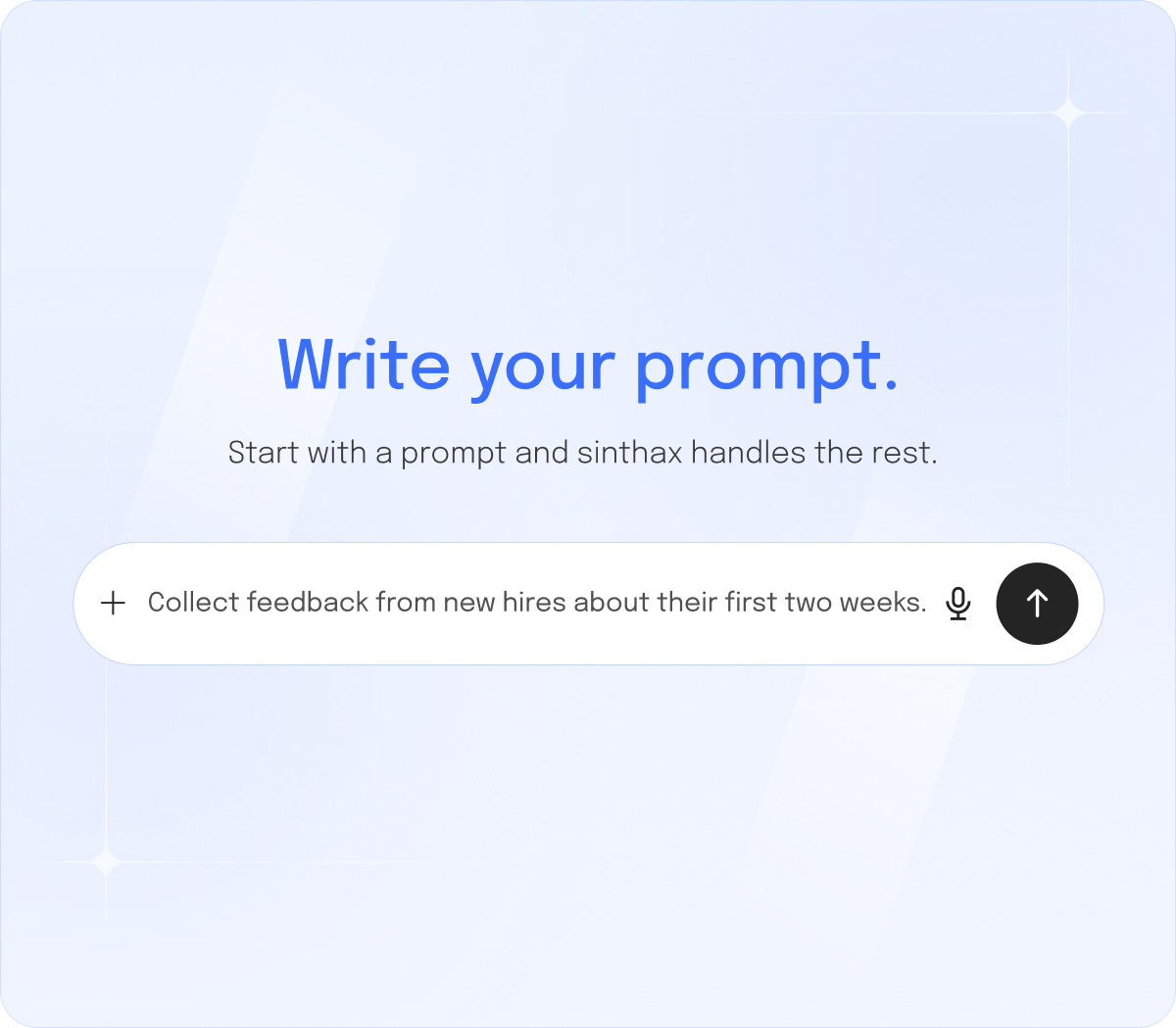
Try Sinthax's instant setup: describe what you want to learn in plain language and get a working conversational form in seconds.
How Do Conversational Forms Work?
The Mechanics: Adaptive Questioning & Real-Time Personalization
Traditional form logic requires you to manually set rules: "If they answer A, show question 5. If B, skip to question 8." You end up with branching trees that get complex fast and still miss edge cases.
AI conversational forms work differently. The AI processes each response as it comes in, identifies key themes or emotions, and decides what to ask next on the fly. It's less like following a flowchart and more like how a skilled interviewer would naturally follow up.
Here's what happens behind the scenes:
- The user types a response
- Natural language processing analyzes the sentiment and extracts key topics
- The AI generates the next question contextually—maybe asking for clarification, probing deeper into something they mentioned, or moving to a new topic if they've exhausted the current one
- This continues until the conversation reaches a natural endpoint
What Makes AI Forms Different from Traditional Forms?
| Feature | Traditional Forms | AI Conversational Forms |
|---|---|---|
| Question flow | Same questions for everyone, fixed order | Adapts based on individual responses |
| Logic setup | Manual branching rules you build | AI determines next questions automatically |
| User experience | Fill in boxes, click next | Natural conversation, like texting a person |
| Response depth | Shallow, checkbox answers | Detailed qualitative feedback |
| Analysis | Export to Excel, manual review | Automatic summarization and action suggestions |
| Follow-ups | Pre-programmed only | Dynamic, contextual probing |
The difference shows up most in the quality of responses. Traditional forms get "Good" or "Needs improvement." Conversational forms get "The checkout process is confusing because the shipping options don't show up until after I enter payment info, which makes me nervous about hidden costs."
That level of detail is the difference between knowing something's wrong and knowing exactly what to fix.
Benefits of AI Conversational Forms for Businesses & Researchers
Higher Engagement & Completion Rates
People don't finish traditional forms for a simple reason: they're boring and feel like work. Conversational forms feel more like messaging a friend who's genuinely interested in your opinion.
The results show improvement. While standard online forms see low completion rates, conversational formats regularly perform better.
Why the difference? Conversational interfaces require less cognitive load. Instead of scanning a page of 20 questions and feeling overwhelmed, users see one question at a time in a familiar chat format. Each response gets acknowledged, creating a sense of dialogue rather than interrogation.
Richer, More Actionable Insights
Static forms force you to choose between quick (but shallow) multiple choice or time-consuming (often skipped) open-ended questions. Conversational AI gives you both.
The AI can start broad, then drill into specifics when someone mentions something important. If a customer says your product is "hard to use," a traditional form moves on. A conversational form asks which part is difficult, when they encountered it, and what they expected instead.
Platforms like Sinthax take this further with automatic response summarization. Instead of reading through hundreds of chat transcripts, you get instant summaries highlighting key points and important insights across all responses. The AI even suggests concrete next actions based on what people told you.
This matters when you're trying to prioritize product roadmap items or understand why customers churn. You get the "why" behind the data, not just the numbers.
Efficiency & Automation
Traditional form analysis means exporting CSV files, reading through responses, categorizing feedback manually, and building reports. For many responses, that's hours or days of work.
AI conversational forms handle analysis automatically. Each response gets summarized in real-time. Important insights emerge across conversations. Sentiment gets scored. Urgent issues get flagged.
You can scale to many responses without scaling your team. The AI does the heavy lifting of synthesis, letting you focus on acting on insights rather than extracting them.
Enhanced Data Quality and Diversity
Form fatigue is worse for people who get bombarded with feedback requests. Long forms on desktop screens exclude mobile users (who now make up 60%+ of web traffic). Complex language barriers exclude non-native speakers.
Conversational formats reduce these barriers. Mobile-friendly chat interfaces feel native on smartphones. Natural language support means people can answer in their own words rather than fitting into your predetermined categories. The back-and-forth structure keeps people engaged rather than overwhelmed by a wall of questions.
You get more complete, honest responses from a broader slice of your audience, which means insights that actually represent your users, not just the subset willing to complete traditional forms.
Sinthax: Built for Speed and Actionable Insights
Sinthax was built around a simple insight: nobody wants to build forms, and nobody wants to fill them out.
Instead of dragging question blocks and setting up branching logic, you describe what you want to learn in a simple prompt. "I want to understand why users abandon their cart" or "I need feedback on our new feature concept." Sinthax's AI creates the entire conversation flow instantly.
Share one link anywhere—email signatures, social posts, your website. Responses come in, and you immediately get summarized insights with smart action suggestions for each piece of feedback. No manual analysis, no endless spreadsheets.
This approach works for founders validating ideas, marketers qualifying leads, and researchers conducting studies—anyone who needs real answers fast.
Try Sinthax free with no credit card required.
Real-World Applications: Use Cases of AI Conversational Forms
Market Research
Traditional market research means recruiting panels, moderating focus groups, or sending forms that many in your target audience ignore. Conversational AI forms let you reach people at scale while maintaining the depth of qualitative interviews.
Example: A DTC brand wants to understand why customers prefer competitors. Instead of asking "Why did you choose Brand X?" (which gets generic answers like "better quality"), a conversational form digs deeper. What specifically about the quality? How did you first hear about them? What almost made you choose us instead?
This uncovers insights like "Your product looked great, but I couldn't tell from your site if it would fit my use case, so I went with the competitor whose site had a detailed comparison chart." That's actionable intelligence you can use to improve messaging, not just a data point that "quality matters."
Product Development & Feedback
Product teams drown in feature requests but struggle to understand which ones actually solve real problems versus which ones are just nice-to-haves someone thought of once.
Conversational forms let you collect ideas and simultaneously probe the underlying need. When someone suggests "Add a dark mode," the AI can ask when they'd use it, what problems the current design causes, and how important it is compared to other potential improvements.
For beta testing, conversational feedback captures the context traditional bug reports miss. Instead of "Search is broken," you get "I tried searching for 'invoice templates' but only got results for 'invoices', I expected to see our template library." That tells developers exactly what's wrong and what the user intended.
Sinthax users building new products use conversational forms to validate concepts before writing code. Describe your idea, share the form with target customers, and get detailed reactions that help you iterate before committing resources.
Lead Generation & Customer Experience
Lead gen forms ask for name, email, company, and role. You get the information but learn nothing about what the person actually needs or whether they're a good fit.
Conversational lead qualification feels less like interrogation and more like a helpful intake. The AI can ask about their biggest challenges, what they've tried before, and what outcomes they're hoping for—while still collecting contact info naturally as part of the conversation.
This gives sales teams qualified leads with context. Instead of a cold name and email, they get "Sarah from XYZ Corp is struggling with manual data entry, tried Zapier but found it too technical, and wants something their non-technical team can use."
For customer experience measurement, conversational NPS follow-ups uncover the "why" behind scores. A customer rates you 6/10—traditional forms stop there or ask a generic "Why?" Conversational forms can explore what disappointed them, what you're doing well, and what would need to change to earn a higher score.
HR and Employee Engagement
Employee pulse surveys suffer from low participation because people don't trust they're actually anonymous or don't believe anything will change. Plus, "Rate your manager 1-5" doesn't tell you much.
Conversational formats feel safer for sharing honest feedback. The dialogue structure lets employees explain context and nuance rather than reducing complex workplace dynamics to a number.
A conversational form about remote work culture might uncover that the issue isn't "communication" (which would rank low on a traditional scale) but specifically that async updates get lost in Slack channels, people don't know what others are working on, and meetings feel like they're just to justify everyone's time.
That specific insight points directly to solutions: better async documentation, shared project dashboards, meeting audits. A traditional form would just tell you "communication score: 3/5" and leave you guessing.
Custom & Hybrid Use Cases
The flexibility of AI conversational forms means you can mix quantitative and qualitative approaches in the same conversation.
Start with structured questions to segment respondents (industry, company size, role), then shift to open conversation to explore their specific challenges. Collect ratings for benchmarking while also gathering stories that explain those ratings.
The common thread: you're collecting data in a format that respects people's time and gets you insights you can actually use.
Getting Started: How to Implement AI Conversational Forms
Step-by-Step Guide
1. Define your goal clearly Don't start by writing questions—start with what you want to learn and why. "Understand why free trial users don't convert" or "Identify which features matter most to enterprise customers."
2. Choose your platform Look for tools that match your technical comfort level and use case. Some platforms require prompt-style setup (describe what you want), while others use more traditional builders with AI enhancements.
3. Create your conversation With Sinthax, you simply describe your goal in plain English: "I want to understand what frustrates users about our onboarding process." The AI generates the conversation flow automatically.
4. Set the tone Conversational doesn't mean unprofessional, but it shouldn't sound like a legal document either. Write like you're asking a colleague for honest feedback—friendly, clear, respectful.
5. Test it yourself Go through the conversation as if you're a respondent. Is it asking for too much? Does it feel natural? Does it actually get to the insights you need?
6. Share strategically Send the link to your target audience through channels they already use. Email works for existing customers. Embedded widgets catch website visitors. SMS can work for follow-ups after specific touchpoints.
7. Monitor responses Check early responses to make sure the conversation is working as intended. If everyone's dropping off at the same point, something's wrong with that part of the flow.
8. Analyze and act Use the automatic summaries to identify patterns and priorities. Share insights with relevant teams. Close the loop by actually implementing changes based on feedback—and telling respondents what you did.
Choosing the Right AI Conversational Form Platform
Evaluation Criteria
Setup ease: How hard is it to create your first form? Do you need to learn complex logic builders, or can you describe what you want and let AI handle it?
Customization: Can you control the conversation flow, branding, and tone? Some platforms let you fine-tune every interaction; others automate most of it.
Analysis depth: Basic platforms just collect responses. Better ones automatically summarize and extract insights. Best-in-class tools use AI to surface insights you wouldn't have found manually.
Support: When something breaks or you can't figure out how to set something up, how quickly can you get help?
Why Sinthax?
Sinthax prioritizes speed and actionability. You can go from idea to collecting responses in under five minutes. The AI handles the conversation flow for you, so you focus on what you want to learn, not how to build it.
Key advantages:
- Instant setup: Describe your goal in a prompt, get a working form in seconds
- Automatic analysis: Every response gets summarized with action suggestions
- Zero learning curve: No complex builders or logic trees to master
- Mobile-optimized: Works seamlessly on any device
Start with Sinthax for free to test the conversational approach without commitment.
Frequently Asked Questions
What is an AI conversational form?
An AI conversational form is an interactive data collection method that uses artificial intelligence to adapt questions in real-time based on individual responses. Instead of static forms, it creates natural dialogue that feels like chatting with a knowledgeable person, resulting in higher engagement and richer insights than traditional forms.
How does an adaptive form tool work?
Adaptive form tools use AI to analyze each response as it's submitted, then automatically generate contextually relevant follow-up questions. If someone mentions a specific problem, the AI probes deeper into that topic. If they give a complete answer, it moves to the next theme. This happens dynamically without requiring you to pre-program every possible conversation path.
Are AI conversational forms better than traditional forms?
For most use cases, yes—especially when you need qualitative depth or struggle with low completion rates. Conversational forms typically see higher completion rates and collect richer, more detailed responses. Traditional forms still work for simple data collection where you just need checkbox answers from large samples and already know exactly what to ask.
How do I get started with Sinthax?
Sign up free at Sinthax, describe what you want to learn in a simple prompt (like "understand why customers cancel subscriptions"), and the AI creates your conversational form instantly. Share the link via email, social media, or embed it on your website. Responses get automatically summarized with action suggestions so you can make decisions immediately without manual analysis.
What's the difference between AI forms and chatbots?
AI forms focus specifically on data collection with structured goals—understanding customer needs, gathering feedback, qualifying leads. Chatbots handle broader conversations including customer support, product questions, and general interactions. Some chatbots include form elements, and some form platforms use chat interfaces, but the core purpose differs.
Can I use conversational forms for quantitative research?
Yes, though they shine brightest for qualitative depth. You can include rating scales, multiple choice, or other structured questions within the conversation flow, then use the AI's adaptive questioning to explore interesting responses more deeply. This hybrid approach gives you both statistical data and the context to interpret it correctly.
Conclusion
AI conversational forms are changing how we collect feedback by replacing static forms with adaptive dialogue that people actually want to complete. The combination of higher engagement, richer insights, and automatic analysis means you spend less time building and reviewing forms while getting better data to guide decisions.
Whether you're validating a product idea, understanding why customers churn, or qualifying leads, conversational approaches consistently outperform traditional forms on both quantity and quality of responses.
Ready to try it yourself? Start free with Sinthax—describe what you want to learn, share your link, and start collecting insights in minutes. No credit card required.